

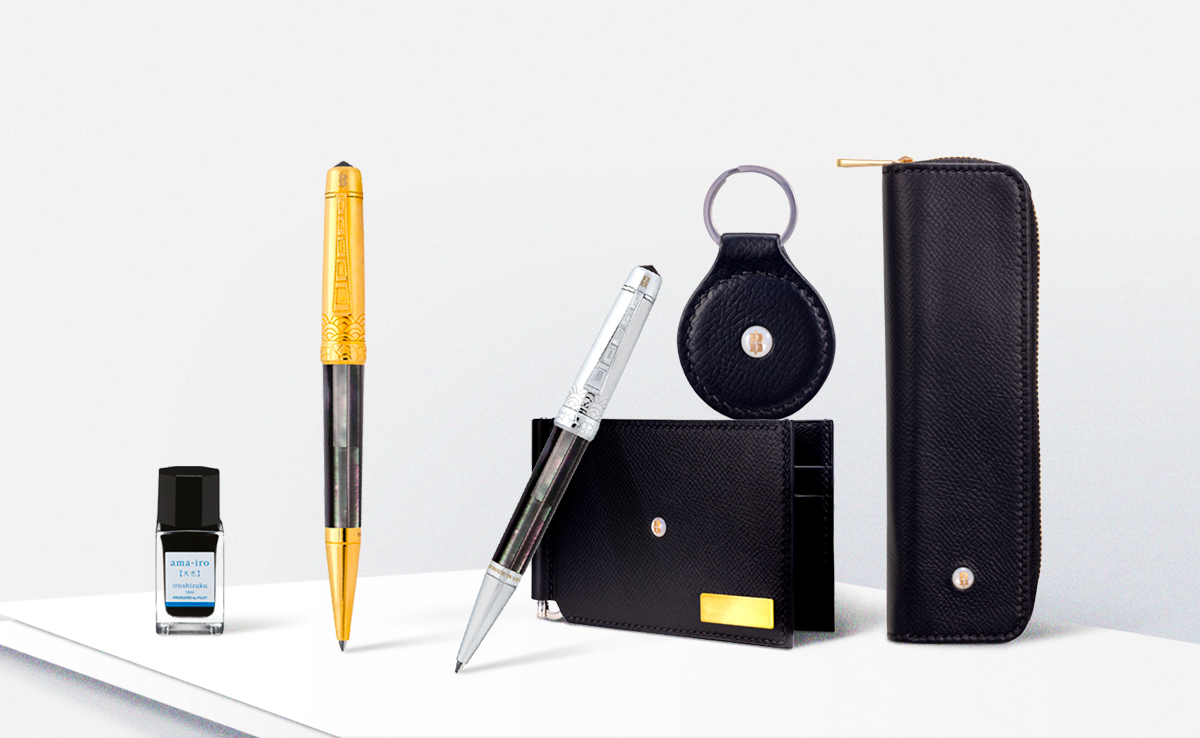
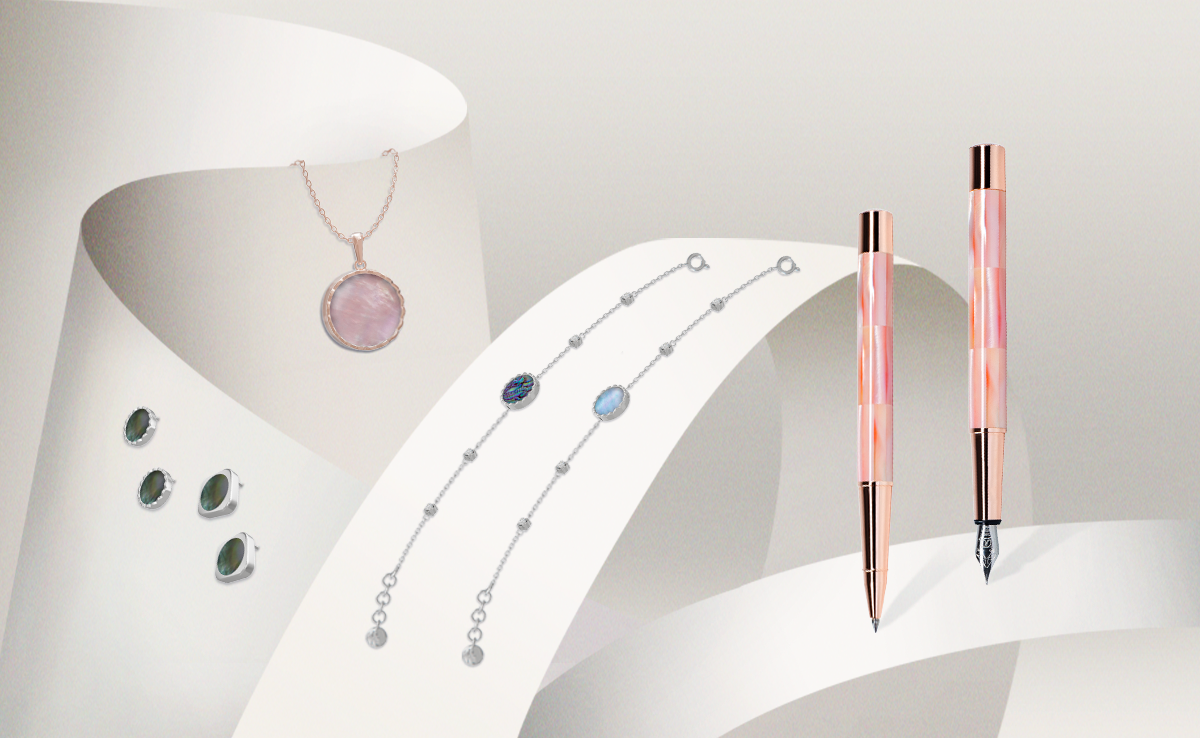
Khảm trai (pronounced kahm chai) is the Vietnamese craft of inlaying mother-of-pearl into a hard surface. Fragments of natural shell are cut to shape, set into recesses carved out of the base material, fixed in place, then sanded and polished until the shell sits perfectly flush with the surface around it. The result is a picture made of shell rather than paint — one that shifts colour as the light and the viewing angle change.
The craft has been practised in Vietnam for roughly a thousand years. It is most closely associated with Chuyên Mỹ commune — the village of Chuôn Ngọ on the outskirts of Hanoi — which has been a centre of inlay work for centuries, and it appears on temple doors, altars, screens, furniture and lacquerware throughout the country. At BLUSAIGON we apply the same technique to writing instruments.
How khảm trai is actually done
There is no machine step in this that matters. The sequence below is how our artisans work in Ho Chi Minh City, and it is broadly how the craft has always been done.
- Selecting the shell. Not all nacre is usable. The artisan looks for even thickness, strong iridescence and freedom from cracks. Different species give different colour: Tahitian black pearl reads dark green-to-purple, New Zealand abalone is blue-green with fire, Northern Australia white pearl is pale and silvery, Mississippi pearls run through pink, orange, brown and purple.
- Cutting. The shell is sawn into thin plates and then cut into the individual shapes the design requires. Nacre is brittle; cutting is slow, and breakage is normal and expected.
- Carving the recess. The base material is carved out to exactly the depth and outline of each piece. If the recess is a fraction too deep or too shallow, the finished surface will never be flush.
- Setting. Each fragment is seated into its recess and fixed. On a complex piece this can be hundreds of individual fragments.
- Levelling and sanding. The whole surface is worked down through progressively finer abrasives until shell and base are one continuous plane.
- Polishing. Final polishing brings out the iridescence. Under-polish and the nacre looks dull; over-polish and you cut through the thin reflective layer entirely.
- Assembly and plating. On a pen, the finished barrel is assembled with its metal components — gold, white gold, rose gold or chrome plated — and the writing mechanism fitted.
A single BLUSAIGON pen barrel takes upwards of 72 hours of handwork. Our workshop in Ho Chi Minh City covers 10,000 m² and employs more than 100 artisans.
Khảm trai and sơn mài: what is the difference?
These two Vietnamese crafts are often confused because they frequently appear on the same object.
| Khảm trai (inlay) | Sơn mài (lacquer) | |
|---|---|---|
| Material | Natural mother-of-pearl and other shell | Resin lacquer, traditionally from the cây sơn tree |
| Method | Shell is cut and set into carved recesses | Dozens of translucent layers are applied, each sanded back before the next |
| Visual effect | Iridescence — colour changes with viewing angle | Depth — you look through layers rather than at a surface |
| Uniqueness | Inherently unique; shell pattern cannot be repeated | Repeatable in colour, though hand-applied |
| Time | Days per piece | Weeks per batch, because each layer must cure |
The two are complementary and are often combined: shell inlaid into a lacquered ground is the classic Vietnamese decorative surface.
Khảm trai and Japanese raden
Readers familiar with fine writing instruments will know raden, the Japanese shell-inlay technique used on high-end urushi pens. Raden and khảm trai are cousins: both set nacre into a prepared ground, both descend from shell-inlay traditions that spread across East and Southeast Asia over more than a millennium.
The difference is emphasis. Japanese raden is usually set into and often finished over with layers of urushi lacquer, so the shell can appear to float beneath a glassy surface, and designs tend toward fine, dispersed particles or precise geometric fields. Vietnamese khảm trai more commonly leaves the shell exposed and flush at the surface, uses larger cut figures, and traditionally favours pictorial subjects — landscapes, birds, figures, calligraphy. Neither is more refined than the other; they are two answers to the same material.
Mother-of-pearl, nacre, abalone: which word means what
- Nacre is the material itself — the iridescent substance a mollusc secretes to line its shell, made of aragonite platelets in layers thin enough to split light. That layering, not pigment, is what produces the colour shift.
- Mother-of-pearl is the common English name for nacre when it is used as a decorative material. The two words describe the same substance.
- Abalone (pāua in New Zealand) is a specific family of sea snails whose nacre is unusually strongly coloured — blues, greens and purples with high fire. All abalone shell is nacre; not all nacre is abalone.
- Pearl is nacre that has formed as a free sphere around an irritant inside the mollusc, rather than as a shell lining. Same material, different geometry.
- Xà cừ is the Vietnamese word for mother-of-pearl; you will see khảm xà cừ used interchangeably with khảm trai.
Why no two inlaid pieces are identical
A mollusc grows its shell over years in a specific set of water conditions. The banding, colour and fire that result are a record of that particular animal in that particular place. Two fragments cut from the same shell already differ; fragments from different shells differ completely. An artisan can control the design but not the material, which is why a hand-inlaid object cannot be reproduced exactly — not as a marketing claim, but as a physical fact.
How to care for mother-of-pearl inlay
- Wipe with a soft dry or very slightly damp cloth. Nacre is calcium carbonate and dissolves in acid — keep it away from vinegar, citrus, and acidic cleaning products.
- Avoid alcohol, acetone, solvents and ultrasonic cleaners, all of which can damage nacre or the setting.
- Avoid prolonged direct sunlight and dry heat, which can cause shell to dull or craze over years.
- Apply perfume, hairspray and hand sanitiser before handling, not after.
- Store in a pouch or box rather than loose against metal or keys — nacre is hard but thin, and scratches at the surface are what dull it.
- Every BLUSAIGON piece is covered by lifetime BluCare+ servicing: bring it to any of our boutiques for cleaning, re-polishing and mechanism maintenance.
A note on heritage status: Vietnamese mother-of-pearl inlay is recognised at national level within Vietnam. The UNESCO Representative List element on mother-of-pearl inlay craftsmanship inscribed in 2023 relates to Azerbaijan and Türkiye, not to Vietnam — a distinction worth keeping straight.
See khảm trai in the hand
BLUSAIGON applies this craft to fountain pens, rollerballs, ballpoints and jewelry. Browse the mother-of-pearl pen collection, read about our crafting process, or visit BLUS MAISON at 129E Nguyễn Đình Chính, Phú Nhuận, Ho Chi Minh City.